16 X 20 African American Family Southern Art Prints
Explore a selection of works past African American artists included in the collection of the National Gallery of Fine art. Choose from the images below to view paintings, photographs, works on paper, and sculpture ranging from a all the same-life painting by
Above: Jacob Lawrence,
To learn more, click the images below.

Drove Highlights: African American Artists Joshua Johnson, The Westwood Children, c. 1807, oil on sail, Gift of Edgar William and Bernice Chrysler Garbisch, 1959.11.1 Joshua Johnson is America'southward primeval-known professional African American artist. Few details of his life are known. The son of an enslaved black woman and a white man, Johnson was born into slavery effectually 1763. A Baltimore County record from 1782 lists Johnson as an amateur to a local blacksmith and states that he was to be freed inside two years. In 1798 and 1802, Johnson advertised his painting exercise in local newspapers, describing himself as a "self-taught genius." Some scholars have suggested that Johnson was influenced past the Peale family unit of painters in Baltimore, particularly Charles Peale Polk. Beginning in the belatedly 1700s, Johnson began to receive portrait commissions from prominent Baltimore-expanse families, including the Westwood family depicted hither. More than lxxx portraits accept at present been attributed to Johnson. In this painting, the three Westwood brothers have merely come inside with freshly gathered flowers and cherries. Accompanying them is the family domestic dog, who firmly grasps a bird captured on their outdoor excursion. The brothers wearable matching trouser suits, fashionable for male children at the time. The younger children, Henry and George, clasp hands, while their older brother, John, extends a protective arm behind them. Johnson'south sympathetic pose of the iii boys makes their brotherly human relationship the subject of this portrait.
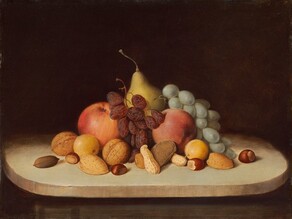
Collection Highlights: African American Artists Robert Seldon Duncanson, Still Life with Fruit and Basics, 1848, oil on lath, Gift of Ann and Mark Kington/The Kington Foundation and the Avalon Fund, 2011.98.1 African American artist Robert Seldon Duncanson was widely recognized during his lifetime for pastoral landscapes of American, Canadian, and European scenery. Recent scholarship, however, has begun to focus on a small grouping of still-life paintings (fewer than a dozen are known) that Duncanson produced during the tardily 1840s. Spare, elegant, and meticulously painted, these works reflect the tradition of American however-life painting initiated by Charles Willson Peale and his gifted children—specially Raphaelle and Rembrandt Peale. Still Life with Fruit and Nuts, signed and dated 1848, is a classically composed work with fruit arranged in a tabletop pyramid. The painting includes remarkable passages juxtaposing the shine surfaces of beautifully rendered apples with the textured shells of scattered nuts. The creative person's turn from nevertheless-life subjects to the landscapes for which he is meliorate known may accept been inspired by Thomas Cole's The Voyage of Life; Cole'due south serial was exhibited in Cincinnati, where Duncanson lived in 1848. Duncanson soon began painting landscapes that incorporated signature elements from Cole and frequently conveyed moral messages. Following the outbreak of the Ceremonious War, Duncanson traveled to Canada, where he remained until departing for Europe in 1865. Often described as the first African American artist to achieve an international reputation, Duncanson enjoyed considerable success exhibiting his landscapes abroad.
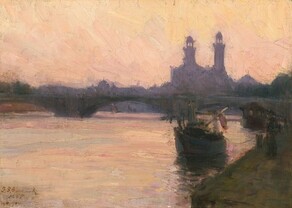
Collection Highlights: African American Artists Henry Ossawa Tanner, The Seine, c. 1902, oil on canvas, Gift of the Avalon Foundation, 1971.57.one Painted eleven years after Henry Ossawa Tanner first settled in Paris in 1891, this apace executed plein-air oil sketch is one of the creative person'southward rare depictions of the French capital. His vantage point is from the right bank of the Seine looking westward toward the towers of the Palais du Trocadéro, the exhibition hall congenital for the 1878 World's Off-white. A diffuse, hazy light fills the scene, which is costless of human being activity save for a alone figure dressed in black at the lower right. With short, loose brushstrokes laden with paint, Tanner captured the scattered reflections of low-cal beyond both river and sky. This pocket-size, evocative painting possesses the mood and mystery that are feature of the artist'southward better-known religious subjects. Tanner was born in Pittsburgh, Pennsylvania, and studied at the Pennsylvania Academy of the Fine Arts under Thomas Eakins. Although Tanner accomplished some success as a painter in the United States, he left for Europe as a young man to escape racial prejudice. Tanner spent most of his professional person career in France, where he exhibited paintings at the Paris Salon and in expositions.
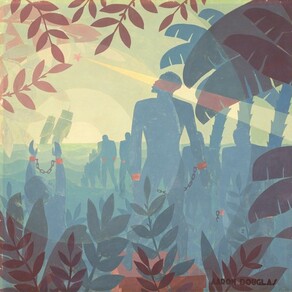
Drove Highlights: African American Artists Aaron Douglas, Into Bondage, 1936, oil on canvas, Corcoran Drove (Museum Purchase and partial souvenir from Thurlow Evans Tibbs, Jr., The Evans-Tibbs Collection), 2014.79.17 Into Bondage is a powerful depiction of enslaved Africans leap for the Americas. Shackled figures with their heads hung low walk solemnly toward slave ships on the horizon. In a gesture of despair, a lone woman at left raises her jump easily, guiding the viewer's centre to the ships. Yet even in this grave epitome of oppression, there is hope. Concentric circles—a motif oftentimes employed by Aaron Douglas to advise sound, particularly African and African American song—radiate from a point on the horizon. The male effigy in the center pauses on the slave block, his face turned toward a beam of low-cal emanating from a lonely star in the softly colored heaven, possibly suggesting the North Star. The homo'due south silhouette breaches the horizon line in a sign of strength and hope. In 1936, Douglas was deputed to create a series of murals for the Texas Centennial Exposition in Dallas. Installed in the elegant entrance foyer of the Hall of Negro Life, his iv completed paintings charted the journey of African Americans from slavery to the present. Considered a leader of the Harlem Renaissance, the cultural phenomenon that promoted African and African American culture as a source of pride and inspiration, Douglas was an inspiring choice for the projection. The Hall of Negro Life, which opened on Juneteenth (June nineteen), a holiday celebrating the stop of slavery, was visited by more than than 400,000 fairgoers over the course of the five months that the exposition was open up to the public. This commemoration of abolitionism, and the mural cycle in particular, served as a critical acknowledgment of African American contributions to state and federal progress. Unfortunately, of the iv original paintings, but 2—Into Chains and Aspiration (Fine Arts Museums of San Francisco)—remain.
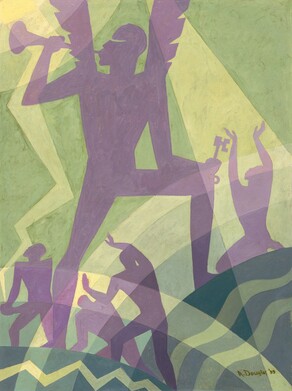
Collection Highlights: African American Artists Aaron Douglas, The Judgment Mean solar day, 1939, oil on tempered hardboard, Patrons' Permanent Fund, The Avalon Fund, 2014.135.1 In 1927 James Weldon Johnson, a key figure in what would come to be known as the Harlem Renaissance, published his masterwork, God's Trombones: 7 Negro Sermons in Verse. Inspired by African American preachers whose eloquent orations he viewed as an art grade, Johnson sought to translate into poesy not just the biblical parables that served as the subjects of the sermons, but also the passion with which they were delivered—the cadency and rhythm of the inspirational language. Identifying blackness preachers as God's instruments on earth, or "God's trombones," Johnson celebrated a central element of traditional black culture. Years before the publication of his poems, while traveling through the Midwest equally a field organizer for the NAACP, Johnson witnessed a gifted black preacher rouse a congregation drifting toward sleep. Summoning his oratorical powers, the preacher abased his prepared text, stepped down from the pulpit, and delivered—indeed, performed—an impassioned sermon. Impressed past what he had seen, Johnson fabricated notes on the spot, simply he did not translate the experience into sermon-poems until several years subsequently. Upon publication, God'southward Trombones attracted considerable attending—non just for Johnson's poetry, but also for the astonishing illustrations that accompanied the poems. Created past Aaron Douglas, a young African American artist who had recently settled in Harlem, the images were an early manifestation of a compositional style that would later go synonymous with the Harlem Renaissance. Drawn past the cultural excitement stirring in Harlem during the mid-1920s, Douglas arrived in New York in 1925. He before long became a educatee of Winold Reiss, a German-born artist and illustrator and early on proponent of European modernism in America. It was Reiss who encouraged Douglas to report African fine art as well as the compositional and tonal innovations of the European modernists. Before long, illustrations by Douglas began appearing in The Crisis, the NAACP publication edited by W. E. B. Du Bois, and Opportunity: The Journal of Negro Life, published by the National Urban League. Impressed by these illustrations, James Weldon Johnson asked Douglas to illustrate his forthcoming book of poems, God'due south Trombones. On short deadline, Douglas created eight assuming and unmistakably modern images that clearly reflect the influence of Reiss also as the creative person's close study of African art. Several years after the publication of God'southward Trombones, Douglas began translating the viii illustrations he had created to accompany Johnson's poems into big oil paintings. The Judgment Day, the last painting in the series of viii, was the first work past Douglas to enter the Gallery's drove. At the heart of the limerick a powerful black Gabriel stands astride earth and ocean. With a trumpet call, the archangel summons the nations of the globe to judgment.
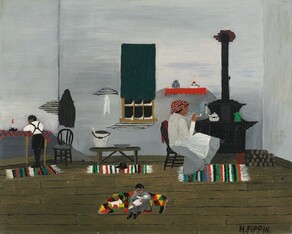
Collection Highlights: African American Artists Horace Pippin,School Studies, 1944, oil on sail, Gift of Mr. and Mrs. Meyer P. Potamkin, in Award of the 50th Anniversary of the National Gallery of Art, 1991.42.i Horace Pippin turned to art later on serving in World War I in the African American regiment known as the Harlem Hellfighters. Pippin was shot by a sniper and lost full utilise of his right arm, receiving an honorable belch from the armed forces. He returned to his hometown of West Chester, Pennsylvania, and taught himself to paint using his left arm to back up his injured arm. Past the late 1930s his work had attracted the interest of such notables every bit the artist Northward. C. Wyeth, critic Christian Brinton, and collector Albert Barnes. This painting belongs to a series of semi-autobiographical domestic interiors that Pippin painted from 1941 until his expiry in 1946, the all-time known among them being Domino Players (Phillips Collection, Washington, DC). Most of these scenes correspond members of African American families pursuing a variety of activities in a unmarried multipurpose room. The paintings all have the same quiet, peaceful ambient and feature many of the same mutual household items, such as rag rugs, quilts, a stove, and an alarm clock. What distinguishes School Studies and gives added significance to the work's title is the mode the iii figures, instead of interacting, accept turned their backs to each other and seem lost in their ain inner worlds.
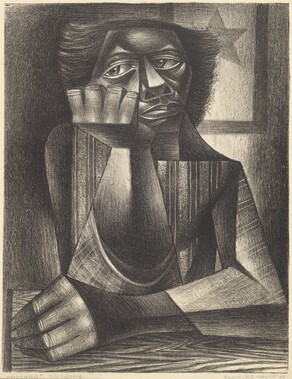
Collection Highlights: African American Artists Charles White,Mother, 1945, lithograph in blackness on wove paper, Souvenir of Jacob Kainen, 2002.98.72 This work is known by two titles: Female parent and Awaiting His Return. The woman who dominates the composition stares into infinite, her strongly modeled figure a study in patience. Given the piece of work'south date (1945), the framed star in the groundwork (a symbol of the Usa war machine), and the give-and-take mother inscribed in the lithograph's lower left corner, the ii titles brand equal sense. The woman's face is easily interpreted as that of a mother waiting for a loved one to render from service in Earth War II. Artist Charles White has chiseled her facial features with determination while infusing her expression with sadness. The cubist faceting of her figure imparts a feeling of solidity and strength in her that is reinforced by her imposing size and foreground placement. Her easily and face are nearly architectural, with their sharp edges and directly-line markings of calorie-free and shadow. Yet her tired optics, her mentum set up into the palm of her manus, and the merest hint of dubiety in her expression signal business organisation. In 1942 White, primarily known as a painter of historical murals, shifted his focus to portraits of everyday African Americans on the advice of Harry Sternberg, an instructor at the Art Students League, New York. White'due south portraits, including Female parent, depict anonymous people dealing with situations common to the black experience. The meticulous draftsman used his skill to return human being emotion and endurance in the face of such obstacles as discrimination. His works from the 1950s, the decade when the ceremonious rights struggle exploded in the United States, testify the price of such perseverance in images of black men and women fighting for social justice.

Collection Highlights: African American Artists Bob Thompson, Tree, 1962, oil on canvas, Collection of Barney A. Ebsworth, 2000.39.3 Bob Thompson's Tree is based on the fantastical, morally charged work of Francisco de Goya, the Spanish master known for his scathing commentary on the Castilian royalty and religious persecution in the late 18th century. Thompson's painting combines two sequent plates from Goya's 1799 drove of etchings Los caprichos: Volaverunt (They Have Flown) on the left and Quien lo creyera! (Who Would Have Thought It!) on the correct. Instead of merely re-creating Goya's etchings, however, Thompson produced a different narrative past modifying the characters and adding new elements. Goya's adulteress becomes a redheaded, winged angel holding an uprooted tree. Her man form watches over several bestial figures, suggesting that human being reason presides over central instincts. To unify Goya's two images, Thompson incorporated the colour red throughout the piece of work and positioned the tree on a diagonal. Thompson attended the University of Louisville in Kentucky before moving to New York City in 1959. In New York he studied the erstwhile masters at the metropolis's museums and became friends with luminaries such as jazz musician Ornette Coleman and multimedia artist Red Grooms. Thompson traveled to Europe on a fellowship, painting Tree in Paris. Like Tree, many of his paintings are renditions of former master compositions. Sadly, Thompson died in Rome of complications after gallbladder surgery at the age of 29, cutting brusk his promising career.
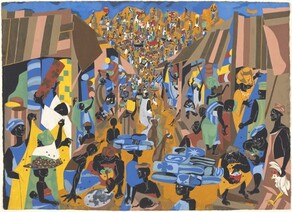
Collection Highlights: African American Artists Jacob Lawrence, Street to Mbari,1964, Gift of Mr. and Mrs. James T. Dyke, 1993.eighteen.ane In Street to Mbari, Jacob Lawrence captured the flurry of a busy outdoor marketplace in Nigeria. Shops line either side of the street while a maze of vendors pending discovery fills the distance. The viewer becomes part of the scene amid a crowd of people, young and one-time, ownership and selling. I can well-nigh hear babies crying, chickens squawking, and people chattering as they discuss fabrics and produce. A cacophony of chief colors heightens the sense of mayhem. Rolls of fabric show off unlike patterns and color combinations. Strips of corrugated iron in varying sizes and colors form the shops' roofs and create a visual rhythm beyond the top of the painting. Lawrence commencement studied African fine art as a swain in New York during the Harlem Renaissance. In 1962 he traveled to Nigeria on an invitation to exhibit his piece of work. In describing the trip, he said, "I became and so excited then past all the new visual forms I found in Nigeria—unusual color combinations, textures, shapes, and the dramatic effect of low-cal—that I felt an overwhelming desire to come dorsum as soon as possible to steep myself in Nigerian civilization so that my paintings, if I'm fortunate, might show the influence of the keen African artistic tradition." It was during a 2nd trip there that Lawrence completed Street to Mbari.
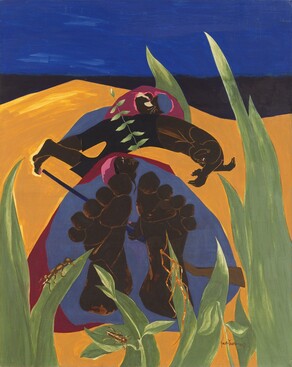
Collection Highlights: African American Artists Jacob Lawrence, Daybreak - A Time to Rest, 1967, tempera on hardboard, Bearding Gift, 1973.8.1 Daybreak - A Time to Rest is i in a series of panel paintings that tell the story of Harriet Tubman, the famed African American woman who freed enslaved people using a fragile network of safe houses called the Underground Railroad. This abstracted image emphasizes Tubman'south bravery in the face of abiding danger. Lying on the hard basis beside a couple and their baby, she holds a burglarize. Her face, pointing upward to the heaven, occupies the near center of the sail, her trunk surrounded past purple. Tubman's enormous feet, grossly out of proportion, become the focal point of the piece of work. The lines delineating her toes and muscles look similar carvings in a rock, as if to emphasize the arduous journeys she has made. Reeds in the foreground frame the prone runaways. Three insects (a walking stick, a beetle, and an ant) are signs of activity at daybreak. Jacob Lawrence is renowned for his narrative painting series that chronicles the experiences of African Americans, which he created during a career of more half dozen decades. Using geometric shapes and assuming colors on flattened motion-picture show planes to express his emotions, he fleshed out the lives of Tubman, Frederick Douglass, John Brownish, and African Americans migrating north from the rural s during and subsequently slavery. Lawrence was 12 in 1929 when his family settled in Harlem, New York, at a time when African American intellectual and artistic life was flourishing there. As a teen, he took classes at the Harlem Art Workshop and Harlem Community Fine art Heart, where he studied works of fine art by African American artists and learned about African art and history. Lawrence went on to create images that are major expressions of the history and experience of African Americans.
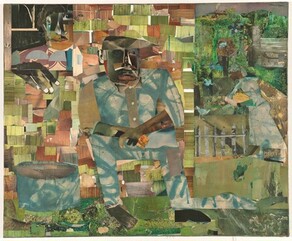
Collection Highlights: African American Artists Romare Bearden, Tomorrow I May Exist Far Away, 1967, collage of diverse papers with charcoal, graphite, and paint on newspaper mounted to sail, Paul Mellon Fund, 2001.72.1 © Romare Bearden Foundation/Licensed by VAGA, New York, NY The championship of this collage could refer to several of its details. In the top right quadrant a nearly camouflaged passing train with billowing smoke travels to an unknown location. The central figure, with a cigarette dangling from his mouth, appears lost in thought. A woman stares at the viewer with a disproportionately large heart, her paw on the windowsill. In the "background" (at correct), bluish birds wing. These elements and others remember Romare Bearden'due south childhood in rural North Carolina and personify journey, a fundamental theme in African American history. The train suggests the Hugger-mugger Railroad—the network of abolitionist-run safe houses that secretly transported people escaping enslavement—and the postal service-slavery migration of African Americans, primarily northward, to seek improve lives. Born in Charlotte, North Carolina, and raised primarily in the surrounding Mecklenburg County, Bearden somewhen settled in New York City to finish college at New York University. He was a social worker there for several decades, during which time he spent nights and weekends on his art. Originally an abstruse painter, Bearden began creating collages in the early 1960s using images from photo-magazines such as Life and Ebony. In addition to his unflinching, faceted images of black life, Bearden is remembered for his published books on art and aesthetics and for his political energy on behalf of black civilisation.

Collection Highlights: African American Artists Sam Gilliam, Relative, 1968, acrylic on canvas, Anonymous Gift, 1994.39.1 Sam Gilliam's draped paintings such as Relative pushed the notion of what painting was and could exist. Past moving his canvases off their stretcher bars, Gilliam allowed them to shift and flow equally material is meant to do. The folds in the canvases, notwithstanding, were non created at random but instead reflect Gilliam's specific idea most how he wanted his paintings to be installed. Relative, while yet hung on a wall, becomes a role of its setting and interacts with and inside that space. Lighting in the room affects the way shadows from the canvas fall on the wall. Physical motility effectually the painting can cause the textile to stir, altering our perception of it. The ample folds demonstrate the painting'due south flexible properties, highlighting nuances of stained colors and hinting at what the creases conceal. Viewers can indulge in the continuous play between activeness and stillness, vivid color and dark shadow. Gilliam was born in Tupelo, Mississippi, and grew up in Louisville, Kentucky. Like Alma Thomas, he settled in Washington, DC, and taught art in the public schools. Besides like Thomas, he was a member of the Washington Color School and the larger colour field movement. Gilliam's experimentations with color and abstraction resulted from an interest in moving away from figurative imagery to adopt colour as the main subject of his paintings.
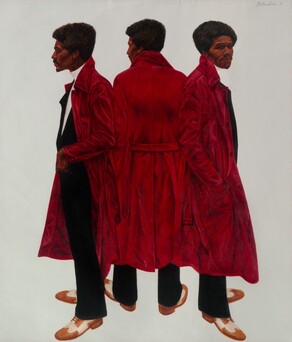
Collection Highlights: African American Artists Barkley Leonnard Hendricks, Sir Charles, Alias Willie Harris, 1972, oil on sail, William C. Whitney Foundation, 1973.nineteen.1 Sir Charles, Allonym Willie Harris offers a tripled image, its unmarried subject captured every bit if in a time lapse. Whether with eyes closed meditatively (on the left) or gazing into infinite (on the right), Sir Charles is alternately thoughtful and vigilant. Larger than life-size, this imposing figure conspicuously signals 1970s mode, popular culture, and the assertion of blackness identity in the generation following the civil rights era. Barkley Hendricks cast his friends, lovers, family unit members, and men and women he met on the street as portrait subjects. Stark and monumental against a monochromatic ground, his portraits fix acutely on the individuality and self-expression of his subjects. Hendricks said that a painting he saw in 1966 while visiting the National Gallery in London—a portrait by Flemish master Anthony van Dyck featuring a scarlet velvet coat—was a bespeak of departure for this work. Intending to brand a replica of the Van Dyck epitome, Hendricks received permission to pigment as a copyist in the museum. Merely once in the process, he realized he could non copy another creative person's piece of work, "no affair how much I similar it," he said. Years later on, he painted Sir Charles with Van Dyck's red coat in mind. Other writers have likened Sir Charles to the iconic three graces—artistic muses (commonly female) equally portrayed past European old masters such as Botticelli and Rubens in three unlike attitudes, one usually with her back toward the viewer. It might be said that Hendricks'southward artistic muses chronicle to classical Western art history equally well every bit sources personal to the artist. Hendricks, who was born in Philadelphia, studied in that location at the Pennsylvania Academy of the Fine Arts and earned BFA and MFA degrees from Yale University. He taught at Connecticut Higher. The recipient of numerous awards and recognitions, he exhibited his piece of work at the Lyman Allyn Art Museum at Connecticut College; the Whitney Museum of American Art, New York; and the Studio Museum in Harlem, New York. The Nasher Museum of Art at Duke Academy organized a career retrospective of Hendricks'southward piece of work, Barkley Hendricks: Birth of the Absurd.
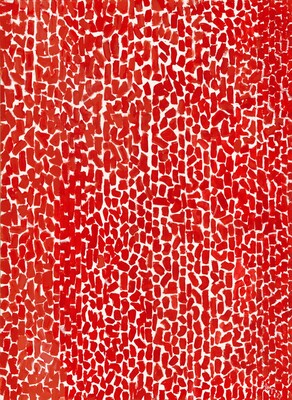
Collection Highlights: African American Artists Alma Thomas, Cherry Rose Cantata, 1973, acrylic on canvass, Souvenir of Vincent Melzac, 1976.6.i The unevenly spaced, staccato brushstrokes on the white canvas grade a visual rhythm, every bit if the artist had painted a cantata, a type of musical composition. Tremendous delicacy is shown in the play of space and color, with the white "background" every bit important to the overall effect as the red bursts of color. The harmonic color field is no blow; the compositional and colour structure of Red Rose Cantata derives from Alma Thomas's interest in nature and music, in its linear organisation with organic variations. Thomas came into the professional art globe late in life, afterward teaching art for 35 years in the Washington, DC, public schools. Her age, however, did not prevent her from gaining recognition as an artist. In 1972, ane year before she painted Cherry-red Rose Cantata, Thomas had a solo exhibition at the Whitney Museum of American Fine art in New York—the museum's first solo exhibition for an African American woman. Thomas and Sam Gilliam were the merely two African American members of the Washington Colour Schoolhouse. She and other artists, Gilliam among them, are associated with the larger colour field movement, which probed the use of solid colour in abstract paintings. Thomas continued painting in her signature style, drawing on nature and music for inspiration, until her death in 1978 at age 86.
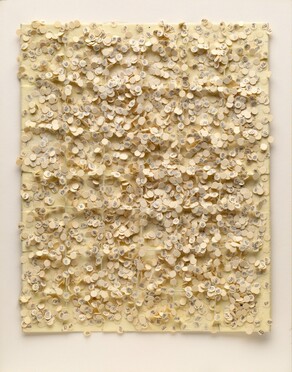
Drove Highlights: African American Artists Howardena Pindell, Untitled, #20, 1974, collage with hole-punched paper dots, pen and blackness ink, monofilament, and talcum powder on oak tag newspaper, Dorothy and Herbert Vogel Collection, 2007.6.303 Untitled, #20 is a collage both intricate and seemingly precarious in its construction. Hundreds of small circular pieces, remnants from a hole-puncher, embrace the surface of the newspaper. Some lie apartment while others cluster in piles or hang off the edges. A filigree created by monofilament provides a substructure for the outwardly haphazard composition, and a lite coating of powder imparts an iridescent quality. Although numbered, each slice is randomly placed. The utilize of numbers and a filigree suggests a mathematical and perchance methodical approach to balancing randomness and premeditation. Howardena Pindell was born in Philadelphia in 1943. She received her BFA from Boston University and her MFA from Yale Academy. Throughout her career, Pindell has used a diversity of techniques and materials in her art, including fabric and video. Like Untitled, #xx, her other work explores construction and texture in the process of making art.
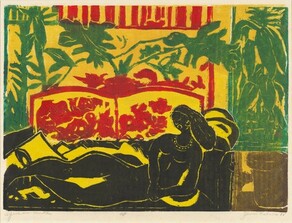
Collection Highlights: African American Artists James Lesesne Wells, African Nude, 1980, color linocut on Japan paper, Gift of Jacob Kainen, 2002.98.246 The woman in African Nude, wearing only a large necklace, reclines on an overstuffed settee. Her alluring position is similar to the pose plant in classic images of odalisques—enslaved women in the Ottoman Empire whose identities became sexualized and popularized during the 19th century. Still unlike the seductive odalisque seen in Western art, whose gaze challenges past staring directly at the viewer, the nude in Wells's work, with eyes downcast, appears unhappily submissive and sick at ease amid the oversize lush plants and gala colors of the background. The viewer is thus left unsettled, as if unwelcome despite the outwardly inviting scene. James Lesesne Wells was built-in in Atlanta, Georgia, in 1902 and received BS and MS degrees from Columbia University. He had a long career in printmaking, first participating in the Federal Art Projection, which encouraged the evolution of fine art in the United States during the Corking Depression, and then educational activity at Howard University in Washington, DC, for most four decades. Wells was active in the civil rights movement and oft depicted the struggles of African Americans in his work. African Nude, which Wells created late in life, reflects his printmaking skill, interest in traditional African aesthetics, and commitment to representing African American history and experiences.
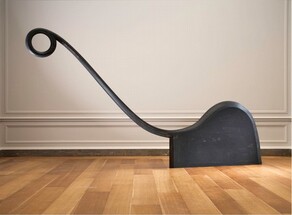
Collection Highlights: African American Artists Martin Puryear, Lever No. 3, 1989, carved and painted wood, Gift of the Collectors Committee, 1989.71.1 In the sweeping silhouette of Lever No. three, a viewer might see either a long-necked fauna or a mechanical arm, as suggested by the work's title. While Martin Puryear's sculptures often recall familiar forms, they encourage individual interpretations. This work explores a frail rest between the heavy, solid-looking "body" and the elegant, weightless accomplish of the giraffe-like "neck." The play between opposing values—heavy and lite, animal and mechanical, space and class, move and stasis—imbues the sculpture with a sense of blitheness, vitality, and changeability. While the primal class of Lever No. 3 appears to be sculpted from a heavy block of forest, it is actually a hollow shell, carefully constructed of thin, bent planks of wood. The sculpture is stained light grey, which unifies its appearance but also creates a somewhat uneven patina that emphasizes its hand-crafted quality. Like Lever No. 3, Puryear's sculptural objects often blend qualities of fine art and finely crafted commonsensical objects. Puryear was born in Washington, DC, in 1941. After earning his BA there from Catholic University, he joined the Peace Corps in Sierra Leone, where he had the hazard to study woodworking techniques such every bit basketry and carpentry. Puryear so attended the Royal Swedish Academy of Fine Arts in Stockholm and independently connected his studies in woodworking. He received an MFA in sculpture from Yale University. In 2007 the Museum of Modern Fine art, New York, organized a 30-yr retrospective exhibition of his piece of work.
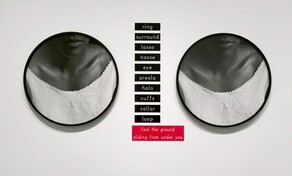
Collection Highlights: African American Artists Lorna Simpson, Untitled (Ii Necklines), 1989, 2 gelatin silver prints and 11 plastic plaques, Souvenir of the Collectors Commission, 2005.44.1.i-3 In Untitled (Two Necklines), identical photographs of an unidentified African American adult female, shown from mouth to breastbone, hang in circular frames, between them a list of words engraved on plaques. The double paradigm suggests tranquility and sophistication: the woman's white shift is make clean and simple, her mouth at ease, the bend of her breastbone elegantly arced. Just the plaques feature words describing circularity and enclosure that are ominously electrified by text on the concluding plaque, which reads, "feel the ground sliding from under you lot." Such meticulous alignments of words and image fuel the subtle yet startling power of Lorna Simpson's work, which for more than than two decades has probed the spectral issues of race, sex, and course. Like this i, her images are frequently truncated, replicated, and annotated with words that forcefulness the viewer to translate. Here, the framed photographs and words inscribed on plaques are literally and metaphorically black and white; the background of the final plaque is a haunting blood cerise. I is hard pressed to deny the implications of this personal yet dehumanized epitome and its bellboy language of racial pathology. Simpson's interest in the relationship between text and images began during her career as a documentary photographer. She received her BFA from the School of Visual Arts in New York and her MFA from the University of California, San Diego. She is recognized equally i of America's ranking masters of potent, poetic work in photography and film. Her works signal what is most personal about identity while simultaneously touching upon clichés and assumptions that can disfigure or destroy it.
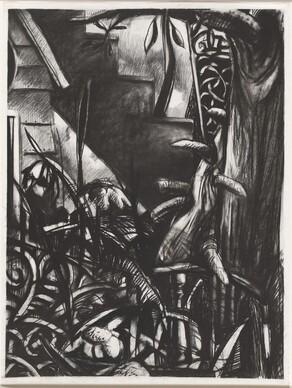
Collection Highlights: African American Artists Joseph Norman, Slum Gardens No. 3, 1990, charcoal on wove newspaper, Souvenir of the Sandra and Charles Gilman, Jr. Foundation in retentivity of Dorothea L. Leonhardt, 1992.20.1 The densely layered image of Slum Gardens No. iii signals claustrophobia. A large tree with a thick, spiked vine winding its fashion upward the trunk defines the right side of the piece of work. Weeds and flowers blanket the bottom half of the image, near obscuring the wooden shack (left) and the staircase. Plants invade a picket fence and piece of railing in the lower foreground. Nosotros sense that the vegetation will shortly overtake the unabridged area, turning the "garden" into a neighborhood menace. The muscularity of the work, emboldened past thick, heavy lines of black charcoal, contributes to the intimidating quality of the plant life. Joseph Norman oft uses landscape imagery to convey pregnant. For this piece of work he drew on his experiences growing up in Chicago and on a 1990 trip to Republic of costa rica, where he witnessed the effects of poverty on various neighborhoods. Slum Gardens No. 3 is not a view of a specific place; rather, it visualizes the concept of "slums" from regions around the world. Here, the overgrowing mural serves as a metaphor for the lack of attending paid to impoverished neighborhoods. Not simply are the physical environments of such areas neglected, merely, as Norman's drawing suggests, its social and economic issues are ignored as well. Norman was born in Chicago in 1957. He received a BS in art instruction from the University of Arkansas at Little Rock in 1980 and an MFA half dozen years later from the Academy of Cincinnati. Later on teaching drawing for 9 years at the Rhode Island School of Pattern, he took a professorship at the Lamar Dodd Schoolhouse of Art at the University of Georgia in 2001.
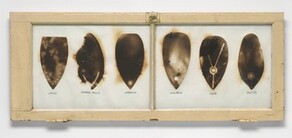
Collection Highlights: African American Artists Willie Cole, Domestic ID, V, 1992, steam-fe scorches with graphite on newspaper mounted in window frame, Gift of Werner H. and Sarah-Ann Kramarsky, 1997.92.4 The imprints of six steam irons mark this work on paper. Below each silhouette, in large capital letters, is the proper noun of an fe manufacturer—Casco, General Mills, Monarch, Silex, Presto, with one "unknown." What do we brand of this image, framed in an old window? For the past 20 years Willie Cole has selected and transformed item items discarded from our vast consumer culture, such as irons, shoes, and lawn jockeys, into objects that resonate with metaphorical meaning—particularly cross-referencing African cultural history and the African Diaspora. The iron silhouettes in Domestic ID, V recollect the slave era in America, when African women served as forced domestic laborers, and the period after emancipation, when they took in laundry as one of the few lines of piece of work open to them. The irons' singed imprints too evoke the rituals of scarification, skilful within certain African and other cultures, and branding, which expunged identity to mark humans every bit slave belongings—perhaps reinforced past the atomic number 26 marked "unknown." Other references inhabit this powerful image, such every bit the similarity of the iron's shape to boats that plied the slave merchandise beyond Europe, Africa, and the Americas, and the nearly-whiff of heat and steam that seems to evoke the hot, backbreaking work of plantation life. Mounting his image in a window, Cole literally reframes history in a mode that summons the readymade fine art of surrealist and Dada artists such every bit Man Ray and Marcel Duchamp. Such wry yet serious correspondences of history, art, and racial politics anchor Cole's reputation in the art world. Educated at Boston Academy School of Fine Arts, the School of Visual Arts (where he received a BFA), and the Art Students League, Cole has exhibited his work throughout the United States, Canada, and Europe.
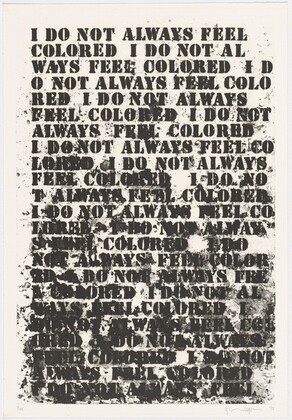
Collection Highlights: African American Artists Glenn Ligon, Untitled: Four Etchings [A], 1992, softground etching, aquatint, spitbite, and sugarlift aquatint in black on Rives BFK paper, Gift of Werner H. and Sarah-Ann Kramarsky and the Collectors Committee Fund, 2004.65.i.1 African American artists working in the 1980s and 1990s often focused on black identity as culturally and socially constructed. Artists including Glenn Ligon moved from using the black figure to employing text as a manner to explore perceptions and understandings of race. In Untitled: Four Etchings [A–D], Ligon quoted from Zora Neale Hurston'south essay "How It Feels to Exist Colored Me" (1928) and Ralph Ellison'due south novel Invisible Human being (1952). Selections from both literary works are written in the first person, often repeating the word "I." In the process of deciphering the text, the viewer becomes the "I" and thus inhabits the person questioning their own self and identity. Untitled: Four Etchings [A] (above) and [B] repeat, over and over, sentences from Hurston's essay: "I do not always experience colored" [A] and "I experience about colored when I am thrown confronting a sharp white background" [B]. As the viewer reads, the texts become increasingly difficult to decipher. Smudged and broken type interferes with legibility, suggesting the viewer'south literal and intellectual struggle to read the judgement and understand its implications. Etchings [C] and [D], both black type on blackness paper, besides make the reader work to comprehend the meaning. Their nearly identical texts taken from Ellison's awe-inspiring novel are nearly indiscernible—"invisible" similar the story's protagonist. Text [C]: Text [D] is the same, except that information technology ends:
I am an invisible homo. No, I am not a spook like those who haunted Edgar Allan Poe; nor am I one of your Hollywood-picture show ectoplasms. I am a man of substance, of mankind and bone, cobweb and liquids—and I might even exist said to possess a listen. I am invisible, understand, just considering people refuse to see me. Like the bodiless heads you see sometimes in circus side-shows, it is as though I have been surrounded by mirrors of hard, distorting glass. When they approach me they meet simply themselves, or figments of their imagina-
...figments of their imagination—indeed everything
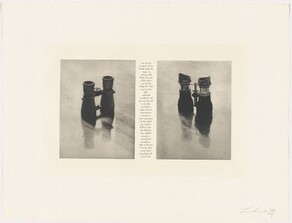
Collection Highlights: African American Artists Lorna Simpson, Two Pairs, 1997, photogravure on handmade Richard de Bas paper, Gift of Graphicstudio/University of South Florida and the Artist, 1998.87.17 Artistically speaking, those with power are normally those who assign a subject's identity. And one time such identity has been given, it accumulates historical authorization as years, decades, and centuries ensue. Central to this phenomenon is the function of gaze—the idea that viewers have the ability to define what they run into. In the fine art of our times, all the same, the potency of gaze has been tested and upended. Hither, Lorna Simpson weighs in. The artist presents two binoculars and, betwixt them, a series of phrases. You might selection up one of these looking devices—possibly to spy?—and thus see what the text haltingly, disjointedly describes. But Simpson has placed the binoculars face down, simultaneously promising and frustrating vision. Text and binoculars each furnish simply partial knowledge, underscoring the inherent problem of relying on only written or visual information to understand a person or situation. Simpson has examined the relationship between text and image over many years, challenging concepts of truth, history, and identity. Hither, gaze is thwarted past its instruments, and knowledge is crippled by incompleteness. You may assign meaning to this epitome, but Simpson reminds the viewer: it is not necessarily correct. Text:
tin can see the wet of her breath while she sings—an interior wall blocks the view of the other—tin can see the badge #'south—full moon perfect light—undressed completely and got into the tub to his left—motionless—kept a log of observations—curvaceous—went unnoticed past the naked eye—tried to hold in view—just shadows—nigh sighted—gruesome—remembered everything—right in the line of vision—they moved three steps back and out of view
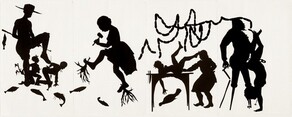
Collection Highlights: African American Artists Kara Walker,Roots and Links, Inc., 1997, black paper collage on prepared wove paper, Corcoran Collection (Gift of the Women'due south Committee of the Corcoran Gallery of Art), 2014.136.226.2 In Walker's cut-paper silhouettes, troubling narratives of violence, animalism, and exoticism play out. Her work draws upon imagery common in the antebellum Southward and is controversial for its use of racial stereotypes of both blacks and whites. Walker focuses on the part of stereotypes in shaping history and their complex function in American race relations today. The abridgement "Inc." in the work's title alludes to the institutionalization of racism and the implicit cultural approval of such degrading images. By suggesting narratives that complicate distinctions between fact and fantasy, victim and predator, blackness and white, Walker'southward piece of work confronts the viewer with the uncomfortable challenge of self-reflection. Born in Stockton, California, in 1969, Walker moved to Atlanta, Georgia, at historic period thirteen. Her transition from an integrated boondocks to the racially divided atmosphere of the South had a profound bear on on her. She received her BFA from the Atlanta Higher of Fine art and her MFA from the Rhode Island School of Pattern, having begun her exploration of the silhouette while in schoolhouse. At age 27, Walker received a John D. and Catherine T. MacArthur Foundation award. Her outset retrospective exhibition was at the Whitney Museum of American Fine art in 2007.
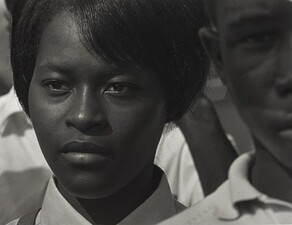
Collection Highlights: African American Artists Roy DeCarava,Mississippi freedom marcher, Washington, D.C., 1963, gelatin silver impress, Robert B. Menschel Fund, 1999.67.3 On Baronial 28, 1963, photographer Roy DeCarava was present for the historic March on Washington for Jobs and Freedom, which culminated in Martin Luther King Jr.'s "I Have a Dream" speech. In this hit photograph, DeCarava turned away from mutual displays of political sit-in—placards and crowds—to capture the confidence, interiority, and stoicism of an isolated marcher. DeCarava described this powerful portrait, with its subtle gradations of gray and black, as representing "a beautiful blackness woman who was beautiful in her blackness. . . . I wanted to pay homage to that person, that spirit." Celebrated every bit one of the first African American photographers to cover and explore the black experience in his art, DeCarava spent much of his career chronicling daily life in Harlem, the civil rights motion, and jazz musicians. His overarching goal, however, was not documentary realism but rather "creative expression," every bit he explained, "the kind of penetrating insight and understanding of Negroes which I believe but a Negro photographer can interpret." No matter the subject field, DeCarava's photographs reveal a keen involvement in exploring the symbolic significance of blackness, as tin can be seen in his evocative, highly acclaimed volume The Sweet Flypaper of Life (1955), a fictional story of life in Harlem with text by Langston Hughes. DeCarava's influence extended far beyond his own photographs. In 1955 he founded A Photographers' Gallery, one of few commercial spaces in New York where photographers—including such emerging artists as Harry Callahan and Small White—could showroom their work.
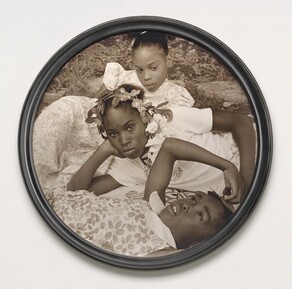
Collection Highlights: African American Artists Carrie Mae Weems,May Flowers, 2002, chromogenic print, printed 2013, Alfred H. Moses and Fern M. Schad Fund, 2014.3.ane May Flowers, a compelling photograph of three immature African American girls, succinctly addresses the issues of race, class, and gender that the American artist Carrie Mae Weems has explored for decades. Related to a video Weems made in 2002 titled May Days Long Forgotten, the photograph evokes both spring's renewal and May 24-hour interval, the international workers' holiday. Conforming these themes, May Flowers depicts girls from working-course families in Syracuse, New York, wearing floral-print dresses. Its tondo format, truncated foreground space, and tight focus on the figures harks back to Renaissance paintings of the Madonna and child, while its subject—adolescent girls with flowers in their hair, lounging on the grass—recalls both 19th-century paintings and photographs, such as those by Édouard Manet and Julia Margaret Cameron. Weems intensified this historical character by printing the photo in sepia tones and placing information technology in a circular frame like those gracing the walls of 19th-century parlors. Yet the color of the girls' skin belies such a history, even as their beauty and knowing expressions—especially the administrative await of the primal figure—challenge viewers to question why they have been excluded for so long. Further complicating and enriching the piece of work, Weems glazed information technology with a piece of convex glass of the type commonly used in 18th- and 19th-century mirrors, as if to suggest that the image represents a reflection of the world at large. Weems received her MFA from the Academy of California, San Diego, and has been honored with numerous awards, including a MacArthur Fellowship in 2013.

Collection Highlights: African American Artists Gordon Parks,Washington, D.C., Mrs. Ella Watson, a Government Charwoman, July 1942, gelatin argent print, printed 1960s, Gift of Julia J. Norrell, 2015.119.one A rich and complex religious practice is displayed in the Washington, DC, habitation of Ella Watson, a cleaning woman who worked for the Farm Security Administration (FSA) during World War II. Her altar—composed of statues of St. Thérèse of Lisieux, Our Lady of Lourdes, St. Joseph, St. Martin de Porres, St. Anthony, and Our Lady of the Immaculate Conception, as well as two elephants, 2 crucifixes, candles, and a rosary—intermingles with her everyday life reflected in the mirror. Appearing in the reflection is a child's doll propped against stacked boxes, while Watson herself wears a floral apron over her polka-dot dress. Through her open window, a Coca-Cola delivery truck and lush summer leaf are visible at the intersection of 11th and P Streets, in northwest Washington. Over the course of a month, the photographer Gordon Parks created a serial of about 90 pictures of Watson, including his nearly iconic photograph, Washington, D.C. Government Charwoman (American Gothic), in which he posed her with a broom and a mop before an American flag. Made nether the auspices of the Historical Section of the FSA, which was headed past Parks's mentor Roy Stryker, the series was not published by the government at the time. Parks purchased his first camera in late 1937 while working equally a waiter for the Northern Pacific Railway. By the early on 1940s he was immersed in some of the most important artistic circles and dynamic photographic projects of his generation. From his rural roots in Kansas, where poverty and racism were widespread, to his meteoric success as a lensman for Life magazine and a filmmaker in Hollywood, Parks was both an instigator and witness of social and aesthetic change during his storied career.
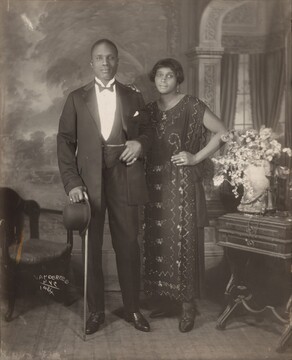
Drove Highlights: African American Artists James Van Der Zee,Couple, 1924, gelatin silvery print, Robert B. Menschel Fund, 2000.83.1 Standing side by side amid elements of middle-class comfort and in front of an elaborately painted properties, the subjects of James Van Der Zee'south Couple exude poise and sophistication. Their elegant dress, direct gazes, and tender yet assured torso language demonstrate confidence and security in their identify in society. Created at the height of the Harlem Renaissance (1919–1929), this photograph exemplifies the spirit of an creative, literary, and social motion that sought to affirm black creativity and cocky-determination in the backwash of World War I and the offset moving ridge of the Corking Migration north. Van Der Zee opened his first independent photography studio in 1916. He subsequently established his GGG Photo Studio, which was named for his wife Gaynella, who assisted with the subtle poses, polished styling, and selective placement of studio props that imbued Van Der Zee's portraits of luminaries and everyday people alike with a cosmopolitan refinement. His famous subjects included pan-Africanist leader Marcus Garvey, poet Countee Cullen, boxers Joe Louis and Jack Johnson, and singers Mamie Smith and Hazel Scott. Self-taught, Van Der Zee began photographing his family and friends in his hometown of Lenox, Massachusetts. His later work as a photographer in Harlem congenital on these familial beginnings by emphasizing motherhood, marriage, and customs through careful collaboration with his sitters to combine their personal identities with their social standing and aspirations. His photographic career continued into the late 1960s with postal service-order retouching and agenda work.
Source: https://www.nga.gov/features/african-american-artists.html

Post a Comment for "16 X 20 African American Family Southern Art Prints"